
Miriad Insight · Miriad LLC
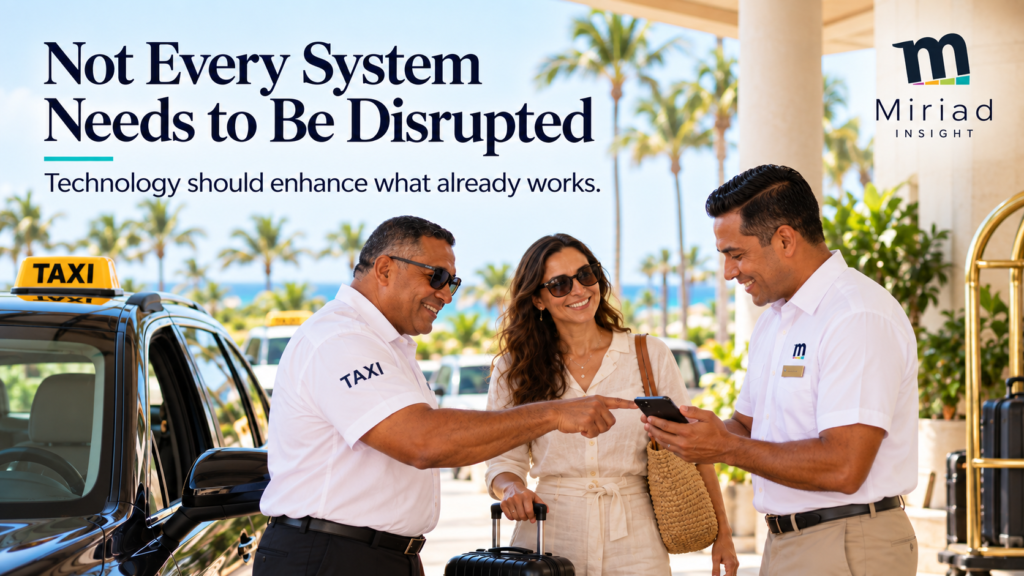
Technology should enhance what already works.
A working system deserves to be understood
Not every system needs to be disrupted. Sometimes it needs to be understood first.
Transportation in Aruba has long depended on independent drivers, local knowledge, hotel coordination, direct communication, practical routines, and relationships built through experience. From the outside, that may not look like a single modern system. It still has structure and value.
Working does not mean perfect. A passenger may need clearer information; a driver may need an easier way to take payment; a hotel may need a more dependable confirmation. Those gaps are reasons to listen closely, not to dismiss the people who already keep the service moving.
Not every system needs to be disrupted. Sometimes it needs to be understood first.
When technology arrives the wrong way
Technology is often introduced with a promise of efficiency, visibility, or smoother transactions. Those are worthwhile goals. The trouble begins when a tool is designed as though the existing workflow is an obstacle rather than the starting point.
A driver can lose independence instead of gaining support. A dispatcher or hotel can inherit extra steps. A passenger can face a more confusing process. Software may be new, yet the work can become heavier.
Useful change asks what people already do well, where confusion appears, and which part of the journey would benefit from a clearer tool. Without that understanding, replacement can become a goal in itself rather than a solution to a real problem.
Enhancement can be more valuable than replacement
Instead of asking, “How do we replace this?”, a better question is, “What already works here — and how can technology make it better?”
That question points toward practical improvements:
- clearer communication between drivers, guests, hotels, and dispatchers;
- easier, more transparent payments;
- records that are simpler to find and understand;
- faster coordination from request through confirmation and ride completion; and
- more certainty for the passenger without taking away operator judgment.
These changes matter because transportation is experienced through people, timing, trust, and coordination—not through a software diagram. A well-placed tool can remove friction while preserving the independence and local experience that give the service its strength.
What already works — and where can technology make it better?
Progress is not always replacement
At Miriad, we believe the real-world workflow should come first and the technology second. That means paying attention to how a request is accepted, how a guest is kept informed, how a ride is completed, and how the people involved handle payment and follow-up.
The aim is not to make the existing transportation network fit an artificial model. It is to build practical tools that help the people doing the work communicate, coordinate, and keep dependable records. Technology is strongest when it supports their judgment instead of trying to overrule it.
Progress does not always mean replacing the system. Sometimes it means understanding the system well enough to improve it.
What should mobility technology improve without replacing?
We believe better transportation technology begins with understanding the people and routines already making the service work. If you work in transportation, tourism, hospitality, or mobility technology, what would you improve while preserving what matters?